How Uninstall Microsoft Office Mac
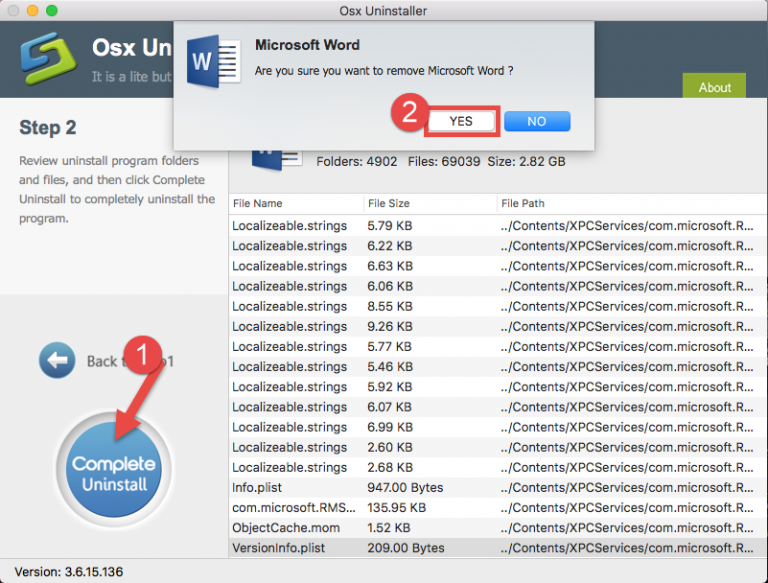
- Microsoft has been readying its latest update to Office for Mac, and recently released its first preview. We decided to give it a whirl and wanted uninstall Office 2011 to avoid any conflicts. Much to our surprise, uninstalling Office 2011 for Mac is a terribly complicated affair.
- Dec 07, 2009 Open Finder. Go to Applications and click on Microsoft Office 2008. Click on Additional Tools. Click on Remove Office. Click on Remove Office. In the new window, click on Continue. The window will now say Locating Office versions.This may take a while, wait until it is done.
Uninstall Office for your installation type. The steps to uninstall Office depend on the type of installation you have. The most common installation types are Click-to-Run and Microsoft Windows Installer (MSI). The other type is an Office installation from the Microsoft Store app.
-->Note
Office 365 ProPlus is being renamed to Microsoft 365 Apps for enterprise. For more information about this change, read this blog post.
Summary
This article contains more information about the following topics that are related to the removal of Office updates:
- The requirements to remove Office updates by using the Add or Remove Programs tool.
- How to determine whether an Office update can be removed by using the Add or Remove Programs tool.
- Known issue that may occur when you try to remove Office updates.
- How to remove an update by using a Microsoft Windows Installer command.
Note Some Office updates cannot be removed. Some examples include the following:
- Service packs
- Office server product updates
- Some updates to Office shared components. In this case, the Microsoft Knowledge Base article that describes the update notes that the update cannot be removed.
More Information
The requirements to remove Office updates by using the Add or Remove Programs tool
The computer that is running Microsoft Office must meet the following prerequisites to use the Add or Remove Programs tool to remove Office updates:
Microsoft Windows Installer version 3.0 or version 3.1 must be installed before you install the removable Office update.
Notes
Microsoft Windows Installer version 3.1 is preferred.
For more information about how to obtain Windows Installer 3.1 (v2), see Windows Installer 3.1 v2 (3.1.4000.2435) is available.
Windows XP Service Pack 2 (SP2) already includes Microsoft Windows Installer 3.0.3790.2180. Additionally, the 2007 Microsoft Office suites require Windows XP SP2.
Windows Server 2003 Service Pack 1 (SP1) already includes Microsoft Windows Installer 3.1.4000.1830.
Windows Vista and Windows Server 2008 already includes Microsoft Windows Installer 4.00.6001.0
The computer must be running Windows Vista, Windows XP SP2, Windows Server 2008, or Windows Server 2003 SP1.
Note When you install either of these service packs, the Add or Remove Programs tool is updated to display Windows Installer updates under the product name.
Removing an Office XP update requires the original installation source to be available. Removing an Office 2003 update requires the original installation source to be available if the Local Installation Source feature in Office 2003 Setup is not used.
How to determine whether an Office update can be removed by using the Add or Remove Programs tool
Windows XP and Windows Server 2003
To determine whether an Office update can be removed by using the Add or Remove Programs tool, follow these steps:
- Click Start, click Run, type appwiz.cpl in the Open box, and then click OK.
- In the left column, click Change or Remove Programs.
- Click to select the Show Updates check box.
- In the Currently installed programs and updates list, click the update that you want to remove.
If the Remove button is available, you can remove the Office update.
How To Completely Uninstall Microsoft Office Mac
Windows Vista and Windows Server 2008
To determine whether you can use the Add or Remove Programs tool to remove an Office update, follow these steps:
You may want all of the most popular programs in a MicrosoftOffice software package, including Word®, Excel®, PowerPoint® andOneNote®. Microsoft access for mac trial download. Versatile Software PackagesIt's easy to select just the right programs for your needs andbudget.
- Click Start, typeappwiz.cpl in the Start Search box, and then press ENTER.
- Under Tasks, click View installed updates.
- Locate and select the update in the list.
- If the update can be removed, theUninstall option will be available in the toolbar.
Known issue that may occur when you try to remove Office updates
The computer meets the prerequisites, but you cannot remove an update.
This issue may occur if the computer did not meet the prerequisites at the time that the update was installed. The computer must be running Windows Installer version 3.0 or version 3.1 before you install the removable update.
How to remove an update by using a Windows Installer
There are some cases in which you do not have the option to remove an update when you use the Add or Remove Programs tool.
If this issue occurs, you can remove the update by using Windows Installer 3.1. The Windows Installer 3.1 redistributable system component will install on the following operating systems:
Microsoft Windows 2000 Service Pack 3 (SP3) and Microsoft Windows 2000 Service Pack 4 (SP4)
Windows XP original release version, Windows XP Service Pack 1 (SP1), and Windows XP SP2
Windows Server 2003 original release version
Note Windows Server 2003 SP1 already includes Windows Installer 3.1.
For more information about how to obtain Windows Installer 3.1 (v2), seeWindows Installer 3.1 v2 (3.1.4000.2435) is available.
Location Based Toll-Free Phone Numbers.  Location Based Toll Phone Numbers. Start a 14-day free trial at www.gotomeeting.comUpdate (v2.0): Users now have the ability to create custom personal meeting rooms or attach existing rooms to a meeting invitation. Meeting URL with Computer (VoIP) Audio. Join from Room System Information.New to GoToMeeting?
Command syntax
With Windows Installer 3.1, you can remove an update by typing a command in the Run dialog box. For example, to remove an update, click Start, click Run, type the following command in the Open box, and then clickOK:
msiexec /package {product_code} /uninstall 'full_path_to_.msp_file' /qb
Notes
When you try to remove an Office update, you may be prompted for your Office source CD-ROM.
The following explains the placeholders for this command:
- The product_code placeholder represents the product code GUID that is associated with the Office product that you installed an update for.
- The full_path_to_.msp_file placeholder represents the full path of the update package (.msp file).
The following explains the parameters for this command:
The /qb switch. If you use the /qb switch, you are prompted if an update is not removable. If you use the /passive switch, you are not prompted if an update is not removable. If you use the /qb switch and if an update is not removable, you receive the following message:Uninstallation of the patch package is not supported.
For example, to remove an update where the product code is '{0C9840E7-7F0B-C648-10F0-4641926FE463}', and the path of the .msp file is 'C:Updatefile name.msp', you would type the following in the Run dialog box:
msiexec /package {0C9840E7-7F0B-C648-10F0-4641926FE463} /uninstall 'c:updatefile name.msp' /qb
Uninstall Office 365 For Mac
To obtain the full path of the .msp file, follow these steps:
Locate the .exe file that you used to install the Office update. If you do not have the file saved to the hard disk drive, download and then save the Office update to a folder on the computer.
Use a file extraction utility, such as WinZip, to extract the files from the .exe update file.
One of the files that is extracted should be a .msp file. This is the file that you must point to when you run the command to remove the Office update.
Note Instead of the full path of the .msp file, you can also specify the patch GUID. For example, to remove an update where the product code is '{0C9840E7-7F0B-C648-10F0-4641926FE463}', and the patch GUID is '{EB8C947C-78B2-85A0-644D-86CEEF8E07C0}', you would type the following in theRun dialog box:
msiexec /package {0C9840E7-7F0B-C648-10F0-4641926FE463} /uninstall {EB8C947C-78B2-85A0-644D-86CEEF8E07C0} /qb
The third-party products that this article discusses are manufactured by companies that are independent of Microsoft. Microsoft makes no warranty, implied or otherwise, about the performance or reliability of these products.
References
For more information about how to remove Office updates that are installed by using Windows Installer version 3.0 or version 3.1, see Uninstalling Patches.